
Understanding Christmas in Colombia Through Data
In Colombia, it is common to hear that “Christmas starts early.” As early as September, some radio stations schedule holiday music, the first decorations appear, and the idea takes hold that December is just around the corner. But how true is it that interest in Christmas increases so early? To verify this, we analyzed the evolution of Google Trends searches for terms associated with Christmas culture—in music, food, and decoration—and the results show a more nuanced picture than popular belief suggests.
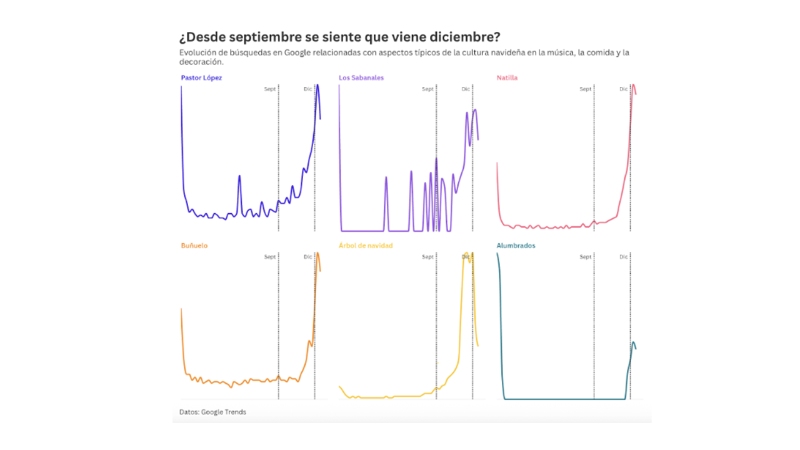
The graph compares the search volume throughout the year for keywords such as Pastor López, Los Sabanales, natilla, buñuelo, Christmas tree, and alumbrados (Christmas lights). The dotted lines mark September and December, two key moments to observe if interest begins to grow before the official holiday season.
In the musical realm, the anticipated rise is evident. Searches related to holiday artists and songs, such as Pastor López and Los Sabanales, show a clear spike starting in September. Although interest does not yet reach its maximum peak—which occurs in December—a sustained upward trend is observed starting from that month. This coincides with a widely recognized cultural practice in Colombia: Christmas music begins to play weeks, and even months, in advance, especially on the radio and in commercial spaces. In this case, the data supports the perception that “December comes early,” at least musically.
The behavior is different when looking at other traditional elements. In the case of traditional food, such as natilla and buñuelo, interest remains low and relatively stable during most of the year. It is not until late November and, above all, in December that searches skyrocket. This suggests that, unlike music, these foods remain strongly associated with actual consumption during the Christmas season and not so much with symbolic anticipation.
Something similar happens with decoration and public space elements. Searches for Christmas tree and alumbrados remain practically at zero for much of the year and only grow abruptly as December approaches. In these cases, there is no evidence of a significant increase in interest since September. The material preparation for Christmas—buying decorations, visiting light displays—seems to follow a more traditional calendar concentrated in the last weeks of the year.
Taken together, the data shows that the idea of an “early” Christmas in Colombia is partially true. The early start exists, but it is not homogeneous. It manifests most clearly in music, an area where tradition and cultural custom weigh more than practical necessity. In contrast, for food and decoration, interest remains anchored to December.
Thus, Google searches allow us not only to measure curiosity or information consumption but also to observe how different traditions are activated at different times of the year. September may sound like December on the radio, but in other aspects, Christmas still keeps us waiting.
